Concealed AC or Split? How to Choose a Cooling System Without Sacrificing Your Home's Beauty or Budget?
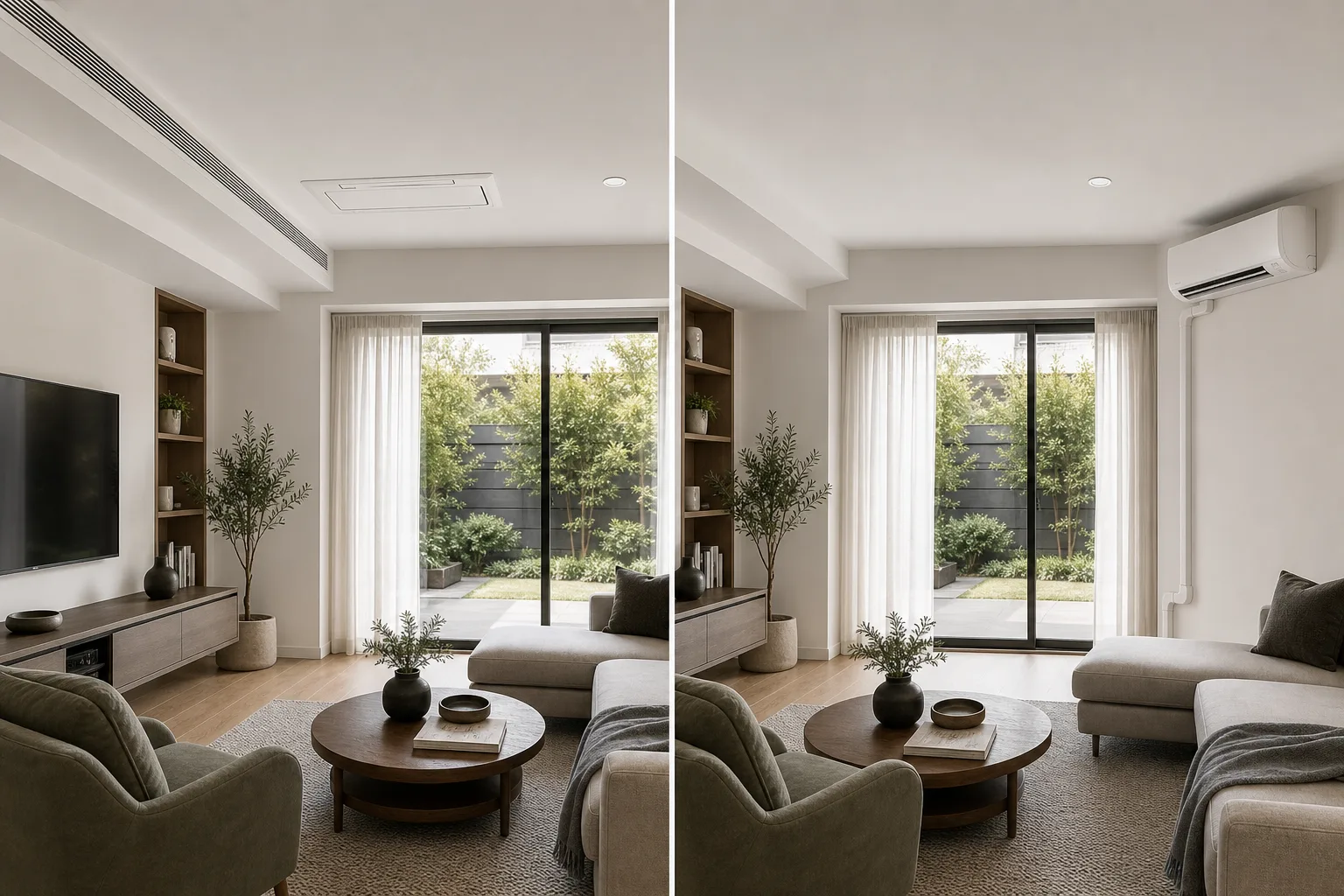
In our Gulf climate, air conditioning is not a luxury, but a necessity of life. However, it's no longer just about "cooling". Today, air conditioning has become an integral part of interior design.
The question that True Draft clients constantly ask us: "I'm impressed by the concealed AC in hotels, but is it practical? Can my budget handle it? Or should I stick with split units?" Today we put the dots on the letters to help you make the right decision for your project.
1. Wall-Mounted Split Units: The Practical and Economical Solution
It's the traditional known system (external unit and internal unit mounted on the wall).
Advantages:
- Cost: It's the cheapest option without dispute (purchase, installation, and electricity consumption).
- Maintenance: Very easy and doesn't require maintenance openings in the ceiling or highly specialized technicians.
- Ceiling Height: Doesn't require much lowering of the gypsum ceiling, which preserves the room's height.
Disadvantages:
- Aesthetic Appearance: The internal unit protrudes from the wall and distorts the decor appearance, especially in modern reception rooms and living rooms.
- Air Distribution: Air comes out from one point, which may cause cold in one place and heat in another within a large room.
2. Concealed AC: Hotel Luxury
It's the middle ground and most suitable for modern villas. The unit is hidden above the gypsum, and air comes out through "ducts" (air channels) and ends with elegant grills.
Advantages:
- Luxurious Appearance: You don't see a "device" hanging, but only smooth air vents that blend with the ceiling design.
- Perfect Distribution: Air vents can be distributed to cover the entire room quietly (without direct and annoying air flow on those sitting).
- Quiet: The fan sound is hidden above the false ceiling, making it quieter than split units.
Disadvantages:
- Cost: Costs approximately 2 to 3 times the cost of split units (due to ducts, insulation, and complex installation).
- Ceiling Height: Requires space (30-50 cm) above the gypsum, meaning you'll lose part of the net ceiling height.
3. Central Package AC: For Palaces and Open Spaces
A huge unit placed on the roof that feeds large spaces. We rarely use it in medium residential villas due to its very high cost and need for shafts that penetrate the building floors.
True Draft Golden Tip: "Mix & Match System"
You're not forced to choose one system for the entire villa! The smart solution we advise our clients to control the budget is:
- Main Areas (Reception rooms, Living rooms, Master bedroom): Use concealed AC. These areas are the "face of the house" and need the highest levels of luxury and quiet.
- Secondary bedrooms, Kitchens, and Service rooms: Use split AC. This will save you huge amounts without significantly affecting the overall beauty of the house.
When Should You Decide?
A catastrophic mistake some make is postponing the AC decision until after the "structure" is finished. Concealed AC requires foundation in architectural plans (to determine unit locations and ceiling openings). If you finish the structure without accounting for it, you may have to break beams (which is dangerous) or install the AC incorrectly.
Conclusion
Concealed AC is an investment in "property value" and beauty, and split AC is an investment in "saving money". Combining both systems intelligently is the secret to a successful equation.